Mushi Customary Marriage in the Age of the Diaspora
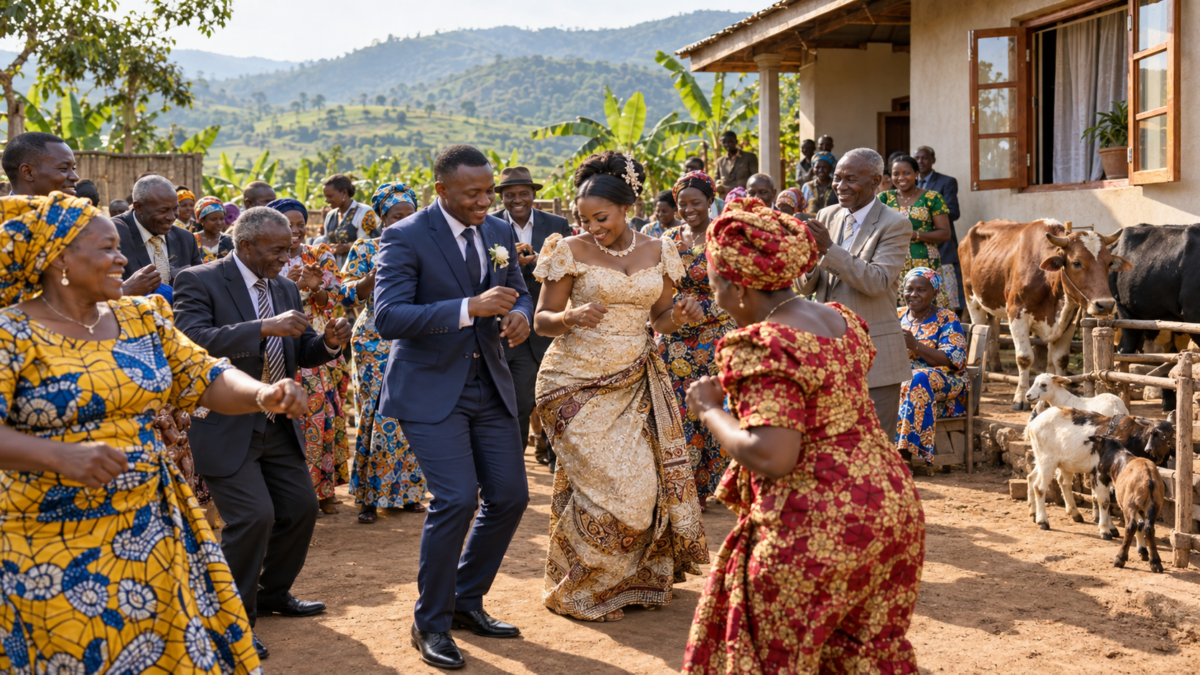
The groom lives in Canada, the bride in Belgium, the families in Bukavu and Walungu. How do you celebrate a tradition made of cows, figurative speech and meetings between families when everyone is scattered?
A generation ago, everything happened across a few hills. The two families knew each other, the elders walked to the bride’s house, and the dowry cow crossed the village to cries of joy.
Today, the negotiation sometimes happens over a video call, the cow becomes a money transfer, and the celebration takes place in a rented hall in Brussels or Montreal, while another is held the same day in the Bushi.
The tradition is changing shape. But what remains of its meaning? And what should we pass on to couples who marry far from home?
The dowry is not the price of a woman. It is the pledge of an alliance between two families.
The steps of tradition
Mushi customary marriage follows a precise order. The details vary from one family and chiefdom to another, but the path remains the same.
Courtship
bushebanyiThe young people get to know each other. In the past, parents often arranged marriages; today, it is mostly the young people who choose each other.
Telling the parents
The young man tells his parents of his intention. The bride, for her part, introduces her suitor to her family.
Sending the elders
bashamukaThe groom’s family sends respected men to the bride’s house. They do the talking, not the couple, who are absent from the discussion.
Figurative speech
The elders never ask for the daughter directly. They say, for example, that they have come to take a little of the household’s fire. The reply is that no one carries off fire without straw: in other words, it is time to talk about the dowry.
Setting the dowry
nguloThe families agree on the number of cows, often one or two. This is not haggling: the ngulo is a gift. Once agreement is reached, the bride may finally appear and greet her future in-laws.
Handing over the cow
The cow is welcomed in the courtyard with a fire, horns and cries of joy. Its lowing is seen as a sign of communion with the ancestors.
Handing over the bride
A rope, symbol of the cow, is placed on a winnowing tray. The bride carries it to her in-laws. Her parents then place her hand in the hands of the groom’s family, who entrust her to their son with a blessing.
The celebration
Songs, dances and banana beer. The couple is escorted to their home. Then come the civil marriage and the religious blessing.
What comes with the cow
The dowry is not only cows. Each gift honours a specific person in the bride’s family.
To thank the parents and relatives who raised the bride. Who receives them varies between families.
For the future mother-in-law, and sometimes a jacket for the father-in-law.
For the aunts, in memory of a farming people.
For the herder who tended the cow.
What the diaspora has changed
| Then, in the Bushi | Today, in the diaspora | |
|---|---|---|
| The cow | Given in kind, in the courtyard | Converted to money, often at the Bukavu market price; ropes stand in for it |
| The elders | Walk all the way to the house | An uncle at home represents the family, or the talks happen by video call |
| The couple | Absent from the negotiation | Often follow everything live on their phones |
| The venue | The in-laws’ home | A rented hall, sometimes two celebrations on two continents |
| Money | A few symbolic gifts | Transfers, plane tickets, costly celebrations |
Excesses we shouldn’t ignore
Many Bashi say it quietly: the dowry sometimes becomes a source of profit. Some families raise their demands, assuming the diaspora “can afford it”. Young people then give up on customary marriage, or live together without the families’ blessing because they cannot pay.
- Escalating demands. A dowry demanded in euros or dollars, with no relation to the real value of a cow in the Bushi.
- Debt. Couples who begin their life together owing money to friends or banks.
- Misunderstanding. When the dowry looks like a purchase, we forget that it was meant to honour an alliance, not set a price.
Six tips for a long-distance marriage
Choose a trusted spokesperson
An uncle or respected elder at home who knows the customs and speaks for the family.
Base the dowry on a clear reference
The price of a cow at a Bushi market is a fair basis, known to everyone and hard to inflate.
Write everything down
What was agreed, what was handed over, and to whom. Distance multiplies misunderstandings.
Remember the aunts and uncles
The gifts due to them are a sign of respect. Forgetting them hurts more than you might think.
Bring the ceremony to those who are absent
A well-organized video call or a video of the celebration lets grandparents bless the couple.
Don’t start married life in debt
A more modest celebration is better than a household weakened from day one.
What to keep, what to leave behind?
Let’s ask the real questions. If the cow is now just an amount on a transfer, does it still carry its meaning? Does a family that demands a high dowry because the groom lives in Europe honour the tradition, or betray it? And why are the couple, the people most concerned, still kept out of the discussions that decide their future?
Figurative speech, respect for elders, the meeting of two families, the parents’ blessing: all of this can cross oceans. Escalating demands and debt, however, were never part of the spirit of the ngulo.
The steps and terms draw mainly on accounts published by the Xaverian Missionaries in Africa and the blog Liba la tolo belango. Customs vary between families and chiefdoms of the Bushi; your corrections are welcome.