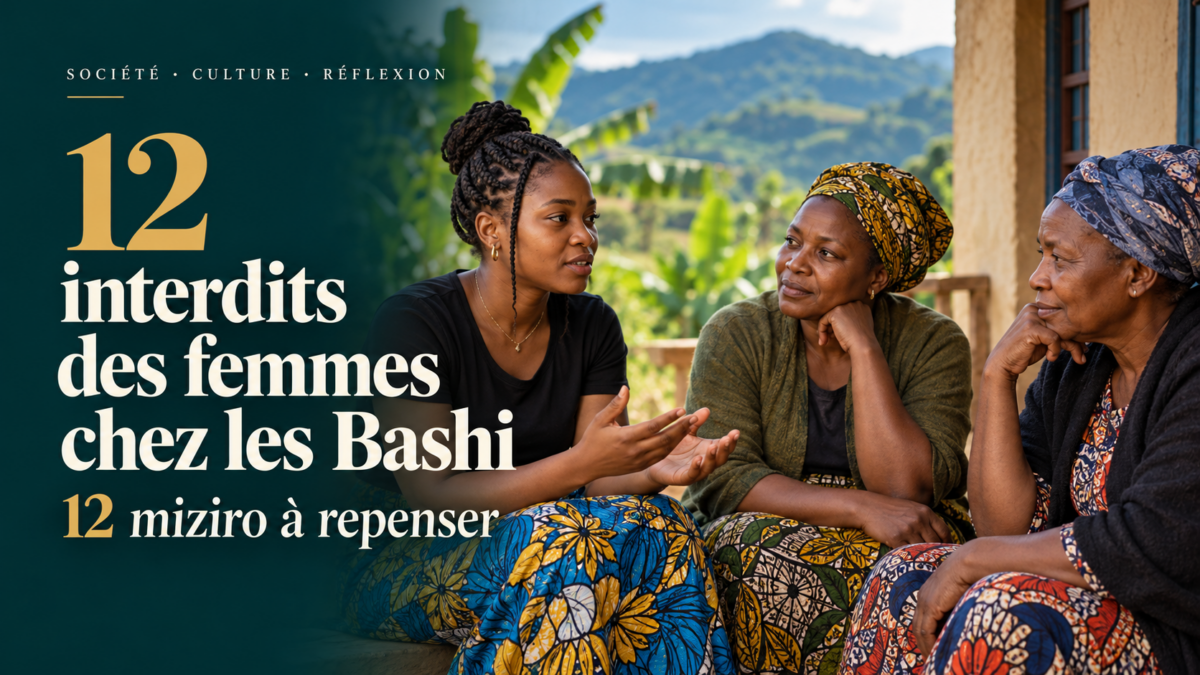
Protective and Discriminatory Taboos Imposed on Bashi Women
Mashi Facile · Culture & Society
From the pestle to the calabash, from the cow to whistling: twelve miziro that long governed the lives of women in the Bushi, somewhere between caution, modesty and domination.
Mashi Facile6 min readBushi, South Kivu
I don’t know whether these taboos, which some would call archaic, are still observed today. But whether they are or not, they must be seen as a violation of women’s rights.
Some present themselves as protective measures: guarding the body, modesty or peace in the home. Others openly state their purpose, which is to keep the woman under her husband’s authority. All of them deserve to be known, if only to understand where we come from.
It is a bad omen. If she had the misfortune to break it, the woman had to abstain from marital relations, because she was struck with a muziro penalty. The mufumu first had to intervene and give the couple a medicinal remedy.
Utensils & home
Never strike anyone with the stirring stick, or break it while making fufu
usipigane na mwiko ao uivunje mu ugali wakati unasonga
This object falls under two kinds of taboo. It must not break while the fufu is being stirred. Nor can it be used as a weapon: neither husband nor wife may use it to hit their spouse during a quarrel.
If this happened, the mufumu had to be called, as for the other miziro, and the couple had to remain abstinent until he had come.
Utensils & home
Never leave the hut once the flour is in the water
Once she has started preparing the fufu, the woman must not leave her hut until she has finished.
Utensils & home
Never go to the spring without a calabash
A married woman may not go down to the river without a container to bring back water. The reason: widows must go and wash in the river to end their mourning.
A woman who went to the river without a calabash would therefore look like a widow, which is a grave insult to her husband.
Husband’s authority
Do not go to cut grass twice in the same day
A Mushi woman must not go to cut the grass used to decorate her hut twice in a row on the same day, for fear that she might meet a lover there.
Husband’s authority
Do not jump over a stretched rope
For fear that she might fall backwards and the children might see her naked.
Body & modesty
Never leave the home while the husband is away
kubunga
A woman may never leave her home when her husband is absent, so that he cannot accuse her of having taken or stolen his goods.
Husband’s authority
Never kick your husband
cipasi / kipasi
The kick might strike the man’s genitals and injure them.
Husband’s authority
Do not climb trees or roofs
The woman might injure her organs while climbing up or down. It is also a taboo of modesty: a woman must never be perched on a roof or in a tree, for fear of exposing her nakedness to everyone. Women at the time wore neither underwear nor trousers.
Body & modesty
Never build a hut
A woman is strictly forbidden to build a house.
Husband’s authority
Do not milk the cow or touch the milk
kukama e’nkafu
Otherwise, it was believed, the cow would stop giving milk, or would give milk that was too thin and watery.
Cattle
Do not whistle
kushungurha
Whistling is an act of authority and freedom. It is forbidden to women because they are placed under their husband’s authority.
Husband’s authority
Protecting women, or holding them down? Behind every taboo, the same question returns.
And today, what do we think?
Let us take the time to look each taboo in the face. Who benefits from it, and who pays the price? Why must a woman who breaks a pestle be kept from her husband, while a man who strikes her with the stirring stick simply shares the same purification? Why should a woman not build a house, when so many mothers in the Bushi raise their children alone and support their households? If milk really spoiled in a woman’s hands, how do we explain that women milk cows all over the world today without the milk suffering for it?
Some of these rules answered the realities of another time, such as the lack of underwear or the fear of being accused of theft. Those realities have changed. Others rest only on the idea that a woman must be watched, suspected and held down. A tradition deserves to be passed on when it protects and brings people together; it deserves to be questioned when it humiliates or confines.
So let us honestly ask ourselves: do these beliefs still make sense in the 21st century? Which ones can we keep as a memory of our culture, and which should we leave behind? And above all, what would we say if our daughters still had to obey them tomorrow?
What remains
Taken one by one, these taboos can seem harmless: a pestle, a calabash, a whistle. Taken together, they describe a life in which a woman may not build, milk, climb, leave, or even whistle.
Knowing them keeps the memory of the Bushi alive. Questioning them means refusing to let them go on dictating women’s place today.
And you? Have you heard of these miziro in your family? Are some of them still observed around you?